
How to Make Espresso at Home Without an Espresso Machine
Learning how to make espresso at home without dropping Rs 25,000–50,000 on a machine is easier than most people think. You won't get a textbook 9-bar shot, but you can get close enough that your morning latte tastes indistinguishable from a cafe version. This guide covers three methods — ranked by how close they get to real espresso — with a step-by-step recipe for the best one.
InstaCuppa sells the Electric Moka Pot featured as Method 1 in this article. All three methods described here work independently of our product — we note where the electric moka pot adds genuine convenience over stovetop alternatives. We earn revenue if you purchase through links in this article.
Can You Make Real Espresso Without a Machine?
Here is the honest truth: an espresso machine forces water through finely ground coffee at 9 bars of pressure (roughly 130 PSI) in 25–30 seconds. That specific combination of high pressure, fine grind, and short contact time creates the thick crema, full body, and concentrated flavour that defines espresso. No stovetop or manual method replicates all three variables perfectly.
But here is the other truth: most people asking how to make espresso at home don't actually want a textbook shot of espresso. They want a strong, concentrated base that works in lattes, cappuccinos, and iced coffees. And for that, several methods get you 80–90% of the way there.
I've tested all three methods below over the past year. Here is how they rank.
Method 1 — Moka Pot (The Best Alternative)
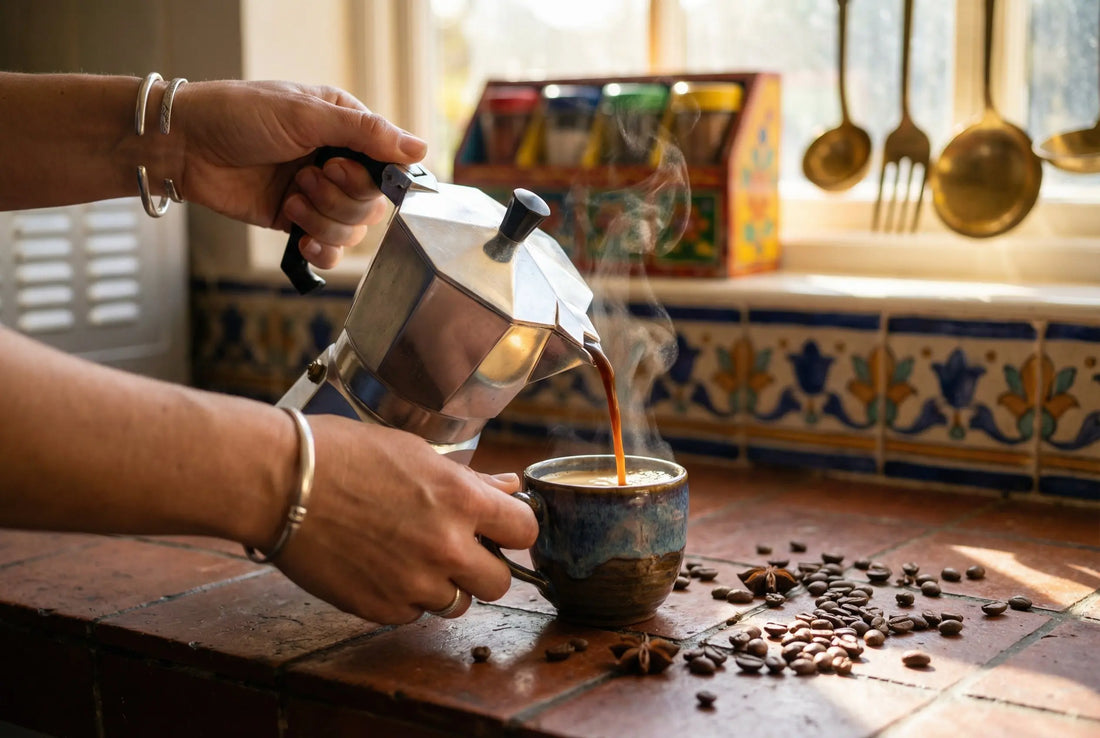
The moka pot was invented in 1933 by Alfonso Bialetti specifically to bring espresso-style coffee into Italian homes — and nearly a century later, it remains the best tool for the job. The brewing principle is simple: water in the bottom chamber heats up, creates steam pressure, and forces hot water upward through a basket of ground coffee into the upper chamber.
The result is a dark, concentrated brew with genuine body and intensity. It won't match the syrupy thickness or crema of a 9-bar machine, but in a latte or cappuccino, the difference fades to almost nothing.
Step-by-Step: How to Make Espresso at Home with a Moka Pot
- Fill the bottom chamber with water — Pour filtered water up to the safety valve (the small dot inside the base). Do not exceed this line. If using an electric moka pot like the InstaCuppa, just fill to the marked line.
- Add coffee to the filter basket — Use a fine-medium grind (finer than drip, coarser than true espresso — think fine table salt). Fill the basket level to the rim. Do NOT tamp or press down — the coffee should sit loosely.
- Assemble the moka pot — Drop the basket into the base. Screw the upper chamber on tightly. If using a stovetop moka pot, use a towel to grip the hot base.
- Start brewing — For an electric moka pot, press the button. For stovetop, place on low-to-medium heat. Never use high heat — it causes over-extraction and bitterness.
- Wait 3–4 minutes — Coffee will begin rising into the upper chamber. It should flow out steadily, not sputter. The InstaCuppa Electric Moka Pot brews at 110°C and auto-shuts off at 125°C, so you don't need to watch it.
- Remove when you hear gurgling — The hissing or gurgling sound means the water is almost gone. If on stovetop, remove immediately. The electric version handles this automatically via thermostat cycling.
Best Coffee to Use
Dark roast beans work best for espresso-style moka pot coffee — they produce more body, less acidity, and that classic "espresso flavour" most people associate with cafe coffee. Good options available in India:
- Blue Tokai Vienna Roast — Rich, chocolatey, low acidity. Excellent for moka pot.
- Continental Xtra — Budget-friendly, widely available. Slightly coarser grind, so ask for moka-pot grind.
- Nescafe Sunrise (instant, for emergency only) — Not real espresso at all, but if you are in a pinch, a heaped teaspoon in 60 ml of hot water gives you something strong enough for a latte base.
Why the Electric Moka Pot Makes It Easier
A stovetop moka pot works perfectly well, but it has one weakness: you need to babysit it. Leave it on the stove 30 seconds too long and the coffee turns bitter. The InstaCuppa Electric Moka Pot solves this with three features:
- Brews at 110°C — optimal extraction temperature, no guesswork
- Auto shutoff at 125°C — prevents over-extraction and burning
- Keep-warm via thermostat cycling — coffee stays hot without degrading flavour
You press a button, walk away, and come back to a strong espresso-style brew in 3–4 minutes. No flame adjustment, no listening for the gurgle, no burnt coffee.
300 ml | Auto shutoff | Keep-warm | Free shipping + 10-day free trial
Method 2 — Aeropress (Clean and Smooth)
The Aeropress was invented in 2005 by Alan Adler (the same engineer behind the Aerobie frisbee). It works like a large syringe: you place coffee and hot water in a chamber, then press a plunger down to force the brew through a paper or metal filter. The manual pressure you apply is roughly 0.35–0.7 bar — far less than a moka pot's 1.5–2 bar — but the paper filter produces an exceptionally clean cup.
How to Make Espresso-Style Coffee with an Aeropress
- Use the inverted method — Flip the Aeropress upside down so coffee steeps without dripping through. This gives you more contact time and a stronger brew.
- Add 17–18 g of finely ground coffee — Slightly coarser than true espresso but finer than drip.
- Pour 60–70 ml of water at 85–90°C — Lower temperature than moka pot because the paper filter and shorter brew time extract differently.
- Stir for 10 seconds, steep for 60 seconds total
- Flip onto a cup and press down slowly (20–30 seconds) — Steady, even pressure is key. Rushing it creates channelling and uneven extraction.
The result: A 60 ml concentrated shot with a clean, bright flavour profile. Less body than a moka pot, but more clarity. Works well in americanos and iced coffees. In milk-based drinks, the lower body means the coffee can get lost if you add too much milk — keep your ratio to 1:2 (coffee to milk) instead of the usual 1:3.
Method 3 — Strong French Press (Cheapest Option)
I want to be upfront: French press coffee is not espresso and it doesn't taste like espresso. Including it here because many readers already own a French press and want to know if they can get close to an espresso-style brew without buying anything new. The answer is "sort of" — with some adjustments.
How to Make Strong Espresso-Style Coffee with a French Press
- Use a high coffee ratio — 30 g of medium-fine ground coffee to 120 ml of water (roughly 1:4 ratio instead of the usual 1:15).
- Grind slightly finer than normal — Standard French press grind is coarse. For this method, go medium-fine. You'll get some silt in the cup, but that adds body.
- Pour water at 95°C, steep for 4 minutes
- Press slowly and pour immediately — Don't let it sit in the press or it will continue extracting and turn bitter.
The result: A strong, full-bodied coffee with noticeable sediment. It has more body than drip coffee but lacks the concentration and sharpness of a moka pot brew. In a latte, it works passably if you use a 1:2 ratio (coffee to milk). In an americano, it just tastes like slightly strong black coffee.
Which Method Tastes Closest to Cafe Espresso?
| Factor | Moka Pot | Aeropress | French Press | Real Espresso Machine |
|---|---|---|---|---|
| Pressure | 1.5–2 bar | 0.35–0.7 bar | 0 bar (immersion) | 9 bar |
| Brew time | 3–4 min | 1–2 min | 4 min | 25–30 sec |
| Crema | Thin, faint | None | None | Thick, golden |
| Body | Full, rich | Medium, clean | Heavy, muddy | Thick, syrupy |
| Best for | Lattes, cappuccinos, americanos | Americanos, iced coffee | Strong black coffee | Everything |
| Grind size | Fine-medium | Fine | Medium-fine (adjusted) | Extra fine |
| Price (India) | Rs 1,999–3,499 | Rs 2,500–3,500 | Rs 500–1,500 | Rs 25,000–2,00,000+ |
| Espresso closeness | 80–85% | 60–70% | 30–40% | 100% |
My recommendation: If you want to know how to make espresso at home and get the closest result to what you'd pay Rs 200–300 for at a cafe, the moka pot is the clear winner. It is the only method that uses actual steam pressure, and the resulting brew has enough body and intensity to stand up to milk without getting diluted.
The Aeropress is a fine second choice if you prefer cleaner, less oily coffee and mostly drink black or with minimal milk. The French press is for people who just want strong coffee — don't buy one expecting espresso.
Frequently Asked Questions
Can I make real espresso without a machine?
Not technically. Real espresso requires 9 bars of pressure and a 25–30 second extraction that no manual or stovetop method can replicate. However, a moka pot produces espresso-style coffee at 1.5–2 bar that is strong, concentrated, and close enough for lattes, cappuccinos, and americanos. Most people cannot tell the difference in milk-based drinks.
What grind size should I use for moka pot espresso?
Fine-medium — finer than drip coffee but coarser than true espresso. Think fine table salt, not powdered sugar. If you use pre-ground "espresso" coffee, it will likely be too fine and choke the moka pot, producing bitter, over-extracted coffee. Ask your roaster to grind specifically for moka pot.
Which coffee beans work best for home espresso?
Dark roast beans produce the most espresso-like results in a moka pot — more body, less acidity, and that classic rich coffee flavour. In India, Blue Tokai Vienna Roast and Continental Xtra are widely available and work well. Freshly ground always beats pre-ground, even with a budget manual grinder.
How does the InstaCuppa Electric Moka Pot differ from a stovetop moka pot?
The brewing principle is identical — both use steam pressure to push water through ground coffee. The electric version adds three conveniences: it brews at a precise 110°C (no guessing flame levels), auto-shuts off at 125°C (prevents over-extraction), and keeps coffee warm via thermostat cycling. You press one button and walk away instead of watching the stove.
Is an Aeropress better than a moka pot for espresso?
For closeness to real espresso, no. The moka pot generates higher pressure (1.5–2 bar vs 0.35–0.7 bar) and produces a more concentrated, full-bodied brew. The Aeropress makes a cleaner, brighter coffee with less sediment — some people prefer that, but it is further from the espresso flavour profile most people are looking for.
Ready to Make Espresso-Style Coffee at Home?
The InstaCuppa Electric Moka Pot brews at 110°C, auto-shuts off, and keeps your coffee warm — no stove-watching required. Rs 3,499.
Shop InstaCuppa Electric Moka Pot — Try Risk-FreeFree Shipping | 1-Year Warranty | 10-Day Free Trial | Free Returns
InstaCuppa is our own brand. We sell the Electric Moka Pot featured as Method 1 in this article. We have recommended it because we genuinely believe it is the most convenient way to make espresso-style coffee at home, but we have also covered two alternative methods that do not require our product. All claims about brewing pressure and temperature are based on product specifications and widely documented brewing science.
Sources & References
- Coffee Market — India — Statista, 2024
- Brewing parameters and coffee quality: Influence of grind size and extraction time — Food Chemistry (ScienceDirect), 2015
- Systematically Improving Espresso: Insights from Mathematical Modeling and Experiment — Nature Scientific Reports, 2020
Founder, InstaCuppa | Building kitchen tools that give busy Indian families their time back. I test every product we sell — including this electric moka pot — in my own kitchen before it goes to yours.

