

Thermos vs Vacuum Flask: Is There a Difference?
Last Updated: April 20, 2026 · By Saran Reddy
People ask "thermos vs vacuum flask — what is the difference?" The short answer: there is no difference in technology. Thermos is a brand name. Vacuum flask is the technology. Every Thermos product is a vacuum flask. But not every vacuum flask is a Thermos. Here is the full story and what it means for your buying decision.

InstaCuppa Fruit Infuser Water Bottle
Infuse fruits directly into your water. BPA-free, 1 litre, full-length infuser rod.
Shop NowWhat Exactly Is a Vacuum Flask?
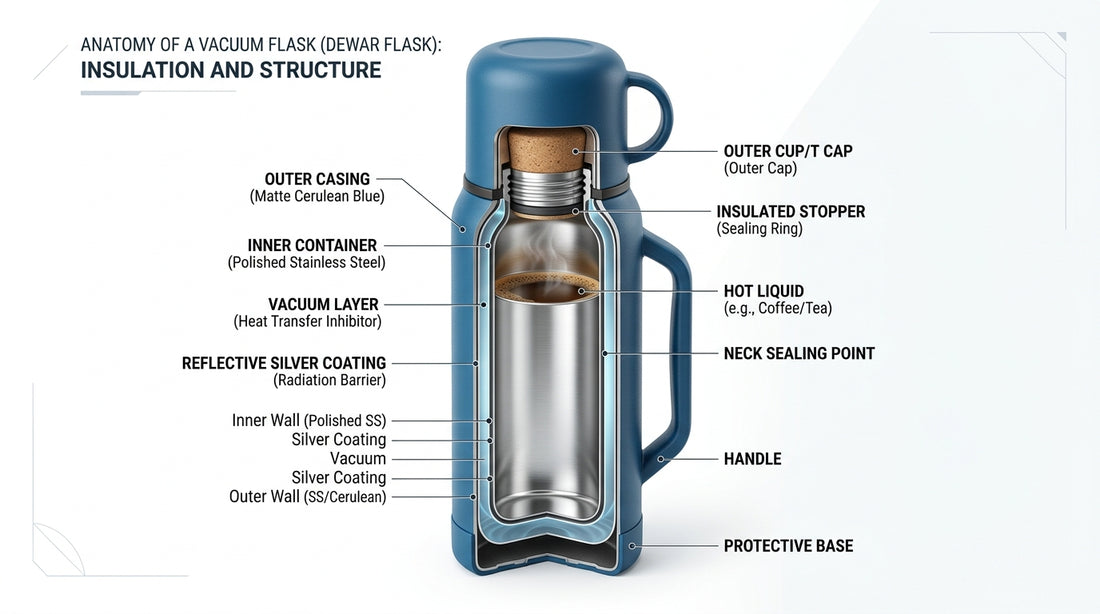
A vacuum flask is a container with two walls and a vacuum (empty space with no air) between them. The vacuum blocks heat transfer. This keeps hot drinks hot and cold drinks cold for many hours.
Heat moves in three ways: conduction (through solid material), convection (through moving air), and radiation (through infrared waves). A vacuum flask stops the first two paths completely.
The two steel walls prevent your drink from touching the outside world directly. The vacuum between them has no air molecules, so heat cannot move by conduction or convection. Only a small amount of heat escapes through radiation.
This is why a vacuum flask can keep your chai hot for 10 to 12 hours while a regular steel bottle loses heat in 1 to 2 hours. The vacuum is the secret ingredient.
What Is the Thermos Brand?
Thermos is a company founded in 1904 in Germany. It was the first to sell vacuum flasks to regular people. The brand became so popular that "thermos" turned into a common word for any vacuum flask.
The story starts earlier, though. In 1892, a Scottish scientist named Sir James Dewar invented the vacuum flask in his lab. He needed it to store extremely cold liquid gases for experiments. He called it the "Dewar flask."
Dewar never patented it for commercial use. In 1904, two German glassblowers — Reinhold Burger and Albert Aschenbrenner — took the design, founded the Thermos company, and started selling it to the public. The name "Thermos" comes from the Greek word "therme," meaning heat.
Over the decades, "thermos" became a generic word. In India, people say "thermos" the same way they say "Xerox" for photocopy or "Colgate" for toothpaste. The brand name replaced the product name in everyday language.
So Is There Any Actual Difference?
No difference in how they work. Both use the same vacuum insulation technology. The only differences are in brand, materials, design, and price. A good vacuum flask from any brand works as well as a Thermos-branded one.
| Feature | Thermos (Brand) | Vacuum Flask (Generic) |
|---|---|---|
| Technology | Vacuum insulation | Vacuum insulation |
| Materials | Premium 304 steel | Varies (304 or 201) |
| Price | Rs 1,500-5,000 | Rs 500-2,000 |
| Heat retention | 12-24 hours | 6-24 hours (depends on quality) |
| Warranty | Often 5+ years | Varies (6 months to 2 years) |
What matters is not the brand name. What matters is: Is it truly vacuum insulated (not just double wall)? Is the steel 304-grade? Is the lid seal tight? These three things decide performance, no matter which brand you pick.
What About the Indian Term "Thermosteel"?
Thermosteel is Milton's brand name for their vacuum insulated bottle range. It is not a type of steel or technology. It is simply a marketing term, just like "Thermos" is a brand name that became common usage.
Milton Thermosteel gets over 22,000 monthly searches in India. Many people think "thermosteel" is a material or technology. It is not. It is Milton's product line name.
Other Indian brands use similar names. Cello has "Lifestyle." Borosil has "Trek." These are all marketing names for the same vacuum insulation technology. Do not get confused by brand names. Focus on the specs: steel grade, insulation type, and retention hours.
What Is the Difference Between Double Wall and Vacuum?
Double wall means two layers of steel. Vacuum means the air between those layers has been removed. Not all double-wall bottles are vacuum insulated. If the gap is filled with air, insulation is 3 to 5 times weaker.
This is the most common mistake buyers make. A product listing that says "double wall insulated" may only have trapped air between the walls. This provides some insulation but nothing close to vacuum.
Look for the words "vacuum insulated" or "vacuum sealed" in the product details. If it only says "double wall" without mentioning vacuum, assume it is air-filled. The price difference is a clue too — vacuum bottles usually cost Rs 200 to Rs 400 more than air-filled double wall bottles.
For a detailed comparison of all insulation types, read our insulated water bottle complete guide.
What Should You Actually Look for When Buying?
Ignore the brand name. Check three things: vacuum insulation (not just double wall), 304-grade stainless steel, and a well-sealed lid. These three features decide how long your drink stays hot or cold.
A Rs 900 vacuum flask from a lesser-known brand can outperform a Rs 2,000 branded flask with poor seal quality. The vacuum does the heavy lifting. The lid seal locks it in. The steel grade keeps it safe.
The InstaCuppa Thermos Flask 1000ml uses all three: vacuum insulation between 304-grade steel walls and a tight silicone gasket in the lid. It keeps drinks hot for 12 hours and cold for 24 hours at Rs 999.
For more on what to check before buying, including BIS certification and lid types, see our complete buyer guide.
The InstaCuppa Thermos Flask uses true vacuum insulation with 304-grade steel. Hot 12 hours. Cold 24 hours. Rs 999.
Frequently Asked Questions
Is a thermos the same as a vacuum flask?
Yes, the technology is the same. Thermos is a brand name that became a generic word, like Xerox for photocopying. A vacuum flask is the technical term for any container that uses vacuum insulation.
Who invented the vacuum flask?
Sir James Dewar, a Scottish scientist, invented the vacuum flask in 1892. He designed it to store liquid gases in his lab. The Thermos company later sold it for everyday use starting in 1904.
Is a Thermos brand flask better than other vacuum flasks?
Not always. The Thermos brand uses quality materials, but many other brands use the same vacuum insulation. What matters is steel grade (304), vacuum seal quality, and lid design, not the brand name.
What is the difference between double wall and vacuum insulated?
Double wall means two layers of steel. If air fills the gap, it insulates partially. If the air is removed (vacuum), insulation improves by 3 to 5 times. Always look for vacuum insulated, not just double wall.
Why do Indians call all vacuum flasks thermos?
Thermos was one of the first brands sold in India decades ago. Over time, the brand name became the common word for the product, just like Indians say Colgate for toothpaste or Xerox for photocopy.
The kitchen takes your mornings, afternoons, and evenings. Your family gets what's left.
InstaCuppa builds time-saving kitchen tools for busy Indian moms — so the kitchen stops stealing the moments you can't get back.
Morning chai without rushing. Evening walks with your kids. Sundays that feel like Sundays.
More time for what matters.
Amazon
Top Brand
10+
Years in Business
5L+
Happy Customers
88%
Positive Ratings
As rated on Amazon.in
Related reading: Electric Flask vs Thermos vs Kettle: What to Buy in India — a plain-language guide to which one boils, which keeps water hot, and what each costs to run.
Names aside, the practical question is which one suits Indian chai. which thermos flask to buy for chai walks through the checklist and how long milk chai stays safe.

