

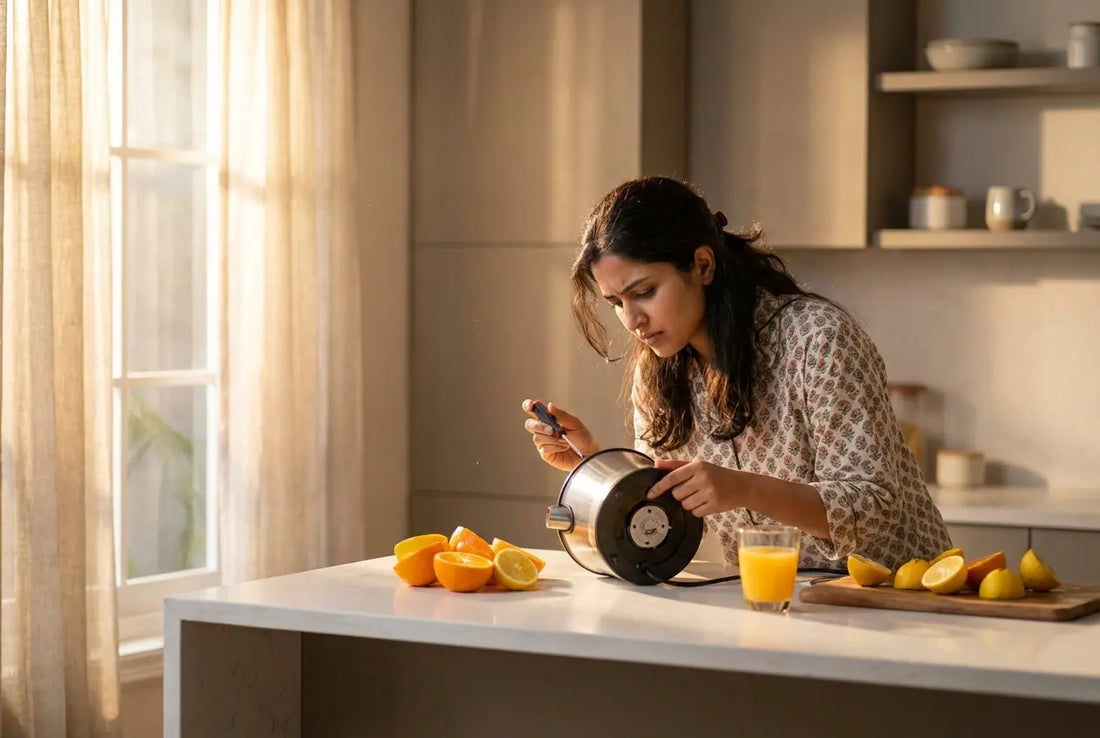
Electric Citrus Juicer Problems: 8 Fixes for Jams, Leaks & More
By Saran Reddy, Founder — InstaCuppa | April 11, 2026 | 7 min read
Jammed Reamer: Why It Stops Spinning
A jammed reamer is the most common citrus juicer problem. It usually happens when dried pulp hardens around the cone base or when you push fruit down too aggressively. The fix is simple: clean immediately after every use and let the motor do the work.
I have seen this happen with our own juicer during testing. When we squeezed 8-10 oranges back to back without pausing, fibrous pulp wrapped around the reamer shaft and the motor stalled. Here is what works:
- Clean between batches. If you are juicing more than 5-6 fruits, lift the reamer, rinse off accumulated pulp, and continue.
- Do not force the fruit. Let the spinning cone pull juice out. Pressing too hard pushes pith and membrane into the mechanism.
- Check for dried residue. Run the reamer under warm water immediately after juicing. Dried citrus pulp becomes cement-like within hours.
If the reamer is already stuck, unplug the juicer, soak the cone assembly in warm water with a drop of dish soap for 10 minutes, then gently rotate by hand. It should free up.
Leaking from the Spout or Base
Leaking usually comes from three places: the drip-stop spout left in the open position, a misaligned container, or worn-out silicone gaskets. Before assuming your juicer is broken, check the spout position first — it solves the problem 80% of the time.
Here is a quick diagnostic:
| Leak Location | Likely Cause | Fix |
|---|---|---|
| Spout dripping | Drip-stop in open position | Rotate spout to closed position after juicing |
| Base of container | Gasket misaligned or worn | Reseat or replace the silicone ring |
| Between container and motor | Container not locked properly | Align and press down until you hear a click |
| Around the reamer | Overfilling the container | Empty juice before it reaches the 400ml mark |
On the InstaCuppa Electric Citrus Juicer, the drip-stop spout is designed to prevent exactly this problem. Just rotate it to the closed position when you are not actively pouring. I keep telling our customers this in support chats — it is the number one complaint that has the easiest fix.
Not Squeezing Enough Juice
If your juicer is leaving fruit halves with visible juice still inside, the issue is usually wrong cone size, cold fruit, or a dull reamer. Matching the cone to your citrus size and using room-temperature fruit can increase yield by 15-20%.
Here is what I have learned from testing hundreds of oranges and lemons:
- Use the right cone size. A small cone on a large orange means most of the fruit never touches the reamer ridges. Our juicer comes with 3 cone sizes specifically for this reason — small for lemons, medium for oranges, large for grapefruits and pomegranates.
- Room temperature fruit. Cold citrus yields 15-20% less juice. Take fruit out of the fridge 30 minutes before juicing.
- Roll the fruit first. Press and roll the whole fruit on your countertop for 10 seconds before cutting. This breaks internal membranes and releases more juice.
- Cut along the equator. Cut horizontally (across the segments), not vertically through the stem. This exposes more juice sacs to the reamer.
Tired of Low Juice Yield?
The InstaCuppa Electric Citrus Juicer comes with 3 interchangeable cones sized for lemons, oranges, and pomegranates — so every fruit gets maximum extraction.
View the InstaCuppa Electric Citrus Juicer — Rs 2,999Motor Overheating or Burning Smell
A burning smell from your citrus juicer means the motor is overworked. Budget juicers with low-wattage motors overheat after 2-3 minutes of continuous use. The solution is simple: juice in intervals and choose a juicer with adequate wattage for your batch size.
Most electric citrus juicers under Rs 1,500 use motors in the 25-40W range. These are fine for 2-3 oranges but struggle with large batches. Here is a general guide:
| Motor Wattage | Continuous Use Time | Best For |
|---|---|---|
| 25-40W | 1-2 minutes | 1-3 fruits, occasional use |
| 80-100W | 3-5 minutes | 4-8 fruits, daily use |
| 150-200W | 8-10 minutes | Large batches, family use |
Our citrus juicer uses a 180W copper DC motor specifically so it can handle a full family batch of 8-10 fruits without breaking a sweat. If your current juicer overheats, give it a 5-minute rest between every 3-4 fruits.
Excessive Noise During Operation
Some noise is normal — a citrus juicer with a spinning reamer will always make sound. But if your juicer has become noticeably louder over time, the usual culprits are a loose container, worn reamer teeth, or debris stuck in the motor housing.
Here is what to check:
- Container alignment. A container that is not seated properly vibrates against the motor base, amplifying noise.
- Surface stability. Place your juicer on a flat, non-slip surface. A wet countertop makes things worse.
- Worn reamer ridges. Over time, the ridges on cheap plastic reamers wear down. The motor works harder to extract the same amount of juice, creating more noise. Stainless steel or BPA-free reamers last significantly longer.
For reference, the InstaCuppa Electric Citrus Juicer runs at about 73 dB — roughly the volume of a normal conversation. If your juicer is significantly louder than that, something likely needs attention.
Too Much or Too Little Pulp
Pulp preference is personal, but your juicer should give you control. If you are getting a thick, chunky glass when you wanted smooth juice (or vice versa), the issue is usually the wrong filter or an old filter with enlarged holes.
Here is how to dial in your pulp level:
- For pulp-free juice: Use a fine stainless steel mesh filter. The metal filter catches even small pulp particles.
- For medium pulp: Use a plastic filter with slightly larger holes.
- For maximum pulp: Remove the filter entirely and juice directly into the container.
Our juicer includes both a plastic pulp filter and a stainless steel filter for exactly this reason. Having two filter options means everyone in the family gets the consistency they prefer.
Maintenance Tips That Prevent 90% of Issues
Most citrus juicer problems are preventable with basic maintenance. Clean immediately after use, never submerge the motor base in water, and store with the container detached. These three habits will keep your juicer running for years.
Here is my maintenance checklist after years of testing juicers:
- Clean within 15 minutes of juicing. Citric acid corrodes seals over time, and dried pulp is nearly impossible to remove without soaking.
- Never use water hotter than 70 degrees Celsius. Hot water warps plastic parts, misaligns gaskets, and causes leaks. Warm water and a soft brush are all you need.
- Wipe the motor base with a damp cloth only. Never submerge it. Water in the motor housing causes short circuits.
- Store with parts separated. Trapping moisture between the container and motor base breeds mould.
- Inspect gaskets monthly. A 2-minute visual check can catch a worn seal before it causes a leak.
Frequently Asked Questions
Why does my electric citrus juicer stop mid-use?
Most electric citrus juicers have a thermal cutoff that triggers when the motor overheats. Unplug the juicer, wait 10-15 minutes for it to cool, and resume. If this happens frequently, you are either juicing too many fruits at once or your motor wattage is too low for your needs.
Can I put my citrus juicer parts in the dishwasher?
It depends on the model. Dishwasher-safe parts are typically marked on the bottom. The InstaCuppa Electric Citrus Juicer has dishwasher-safe removable parts (container, cones, filters). Never put the motor base in the dishwasher.
Why does my juice taste bitter?
Bitter juice comes from pressing too hard and squeezing oil from the citrus peel (the white pith). Apply gentle, steady pressure and let the reamer do the work. Also, avoid juicing the very last bit of the fruit half where the pith is thickest.
How long do electric citrus juicers last?
A well-maintained electric citrus juicer should last 3-5 years with daily use. The motor is rarely the failure point — it is usually the seals and plastic parts that wear out first. Juicers with stainless steel and BPA-free components last longer.
Is an electric citrus juicer better than a manual press?
For daily juicing or batches of more than 3-4 fruits, an electric juicer is significantly faster and requires less effort. Manual presses can extract slightly more juice per fruit (5-10% more) but take more time and physical effort. Choose electric for convenience, manual for occasional small batches.
How do I remove the burning smell from my juicer?
A one-time burning smell after first use is normal (manufacturing residue burning off). If it persists, the motor is being overworked. Reduce batch sizes, ensure the reamer spins freely, and check that no pulp is jamming the mechanism. If the smell continues, contact the manufacturer.
Ready for a Juicer That Just Works?
180W copper DC motor. 3 cone sizes. Drip-stop spout. Dishwasher-safe parts. The InstaCuppa Electric Citrus Juicer is built to avoid every problem on this list.
Shop Now — Rs 2,999 (MRP Rs 3,499)
