

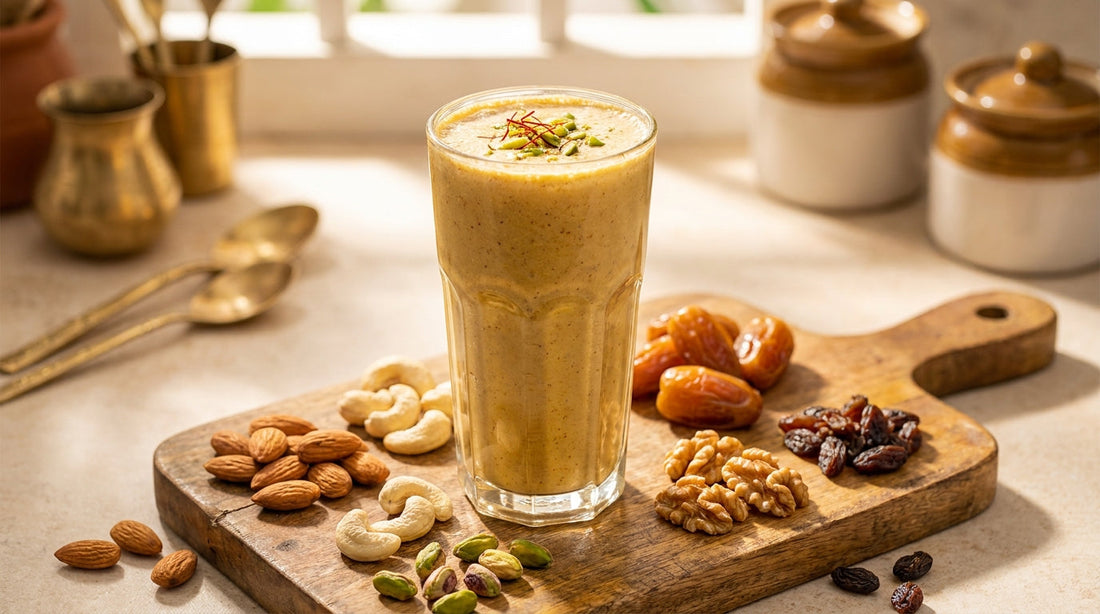
Dry Fruits Shake: Best Protein and Nutrition Guide for Indian Gym-Goers
By Saran Reddy, Founder — InstaCuppa | Published May 2026 | Last updated: 11 November 2026
Dry Fruits Shake: Best Protein and Nutrition Guide for Indian Gym-Goers
A glass of dry fruits milk shake is one of India's oldest health drinks. Your grandmother made it. Your school lunch box had it. But is it actually good for gym? How much protein does it have? And which dry fruits give you the most?
This guide answers everything with real numbers from the ICMR-NIN Indian Food Composition Tables (IFCT 2017) and Health Canada's Canadian Nutrient File (CNF).
Dry Fruits Shake Benefits: What 1 Glass Gives You (Protein, Calories, Fayde)
Badam shake me kitna protein hota hai? (How much protein is in a badam shake?)
Ek glass badam shake (about 16 almonds, or 20 g, plus 250 ml toned milk) me lagbhag 11 se 12 g protein hota hai. The almonds give about 3.7 g (IFCT 2017 lists 18.4 g protein per 100 g of almonds) and the toned milk about 8 g. So milk is the bigger protein source, and badam adds healthy fat, vitamin E and taste.
Dry fruit shake peene ke fayde (benefits of drinking dry fruit shake)
- Protein aur energy: 14 to 20 g protein per glass with milk, plus slow-release energy from nut fats.
- Weight gain ke liye: with full-fat milk and more dates it can reach about 500 to 700 kcal, a natural way to gain weight.
- Baal aur skin: vitamin E from almonds, omega-3 from walnuts, zinc from cashews and almonds.
- Iron aur fibre: dates and raisins add iron, potassium and fibre.
Protein in Common Dry Fruits
Not all dry fruits are created equal. Here is the protein breakdown for the most popular ones:
| Dry Fruit | Protein per 100g | Protein per 10g | Main Use in Shake |
|---|---|---|---|
| Almonds | ~21g | ~2.1g | Best protein dry fruit |
| Pistachios | ~20g | ~2.0g | High protein + great taste |
| Cashews | ~18g | ~1.8g | Good protein, creamy texture |
| Walnuts | ~15g | ~1.5g | Good fats, moderate protein |
| Dates | ~2.5g | ~0.25g | Natural sweetener, iron source |
| Dried figs (anjeer) | ~3.3g | ~0.33g | Fibre, calcium — not protein |
| Raisins (kishmish) | ~3.1g | ~0.31g | Quick energy, sweetness |
Where the numbers come from: the table uses rounded values from Health Canada's Canadian Nutrient File (CNF) for raw nuts and dried fruit. The Indian tables (IFCT 2017, ICMR-NIN) give pistachios 23.4 g, cashews 18.8 g, almonds 18.4 g, walnuts 14.9 g, dried dates 2.5 g and raisins 2.6 g protein per 100 g, so by Indian data pistachios rank first. Dried figs: 3.3 g (CNF).
Bottom line: For protein, use almonds, pistachios, and cashews. Dates, raisins, and figs are for taste, energy, and micronutrients — not protein.
How Much Protein Is in a Classic Dry Fruits Shake?
Let us calculate the protein in a standard Indian dry fruits milk shake:
| Ingredient | Quantity | Protein | Calories |
|---|---|---|---|
| Almonds | 15g | 3.2g | ~87 kcal |
| Cashews | 15g | 2.7g | ~83 kcal |
| Dates | 20g (2–3 pieces) | 0.5g | ~56 kcal |
| Toned milk | 250ml | ~8g | ~150 kcal |
| Total | ~14–15g | ~376 kcal |
How we worked it out: nuts and dates use CNF values per 100 g (almonds 21.2 g protein and 579 kcal, cashews 18.2 g and 553 kcal, dates 2.5 g and 282 kcal). Toned milk in India must have at least 3.0% fat and 8.5% other milk solids (FSSAI). For the milk we used CNF whole milk (3.15 g protein and 61 kcal per 100 g) as a close match. With a little less fat, 250 ml of toned milk comes to about 8 g protein and about 150 kcal.
A classic dry fruits shake gives about 14–15g of protein. That is good for a morning drink. Not enough to be your only protein source for the day, but a solid start.
Best Dry Fruits Combination for Maximum Protein
If you want the most protein from your dry fruits shake, use this combination:
- 20g almonds (~4.2g protein)
- 20g pistachios (~4.0g protein)
- 10g cashews (~1.8g protein)
- 300ml toned milk (~9.6g protein)
Total protein: ~20g. Rough cost: about ₹60–80, depending on local prices. This is a dense, filling, all-natural protein shake.
Avoid adding too many dates, raisins, or figs if protein is your goal. They add calories and sugar but very little protein.
Is Dry Fruits Shake Good for Weight Gain or Weight Loss?
For weight gain: Excellent. Dry fruits are calorie-dense. Full-fat milk + nuts + dates can give you about 500–700 kcal per shake. For example, 300 ml whole milk, 20 g almonds, 20 g cashews, 4 dates and 1 banana come to about 600 kcal. This is one of the best natural ways to gain healthy weight in India.
For weight loss: It can work, but you must control portions. Here is how:
- Use toned or skim milk instead of full-fat
- Limit to 5–8 almonds, 2–3 cashews
- Use only 1–2 dates for sweetness
- No added sugar, honey, or ice cream
A controlled dry fruits shake comes to about 160 kcal (skim milk, 5 almonds, 2 cashews, 1 date). With toned milk, 8 almonds, 3 cashews and 2 dates it is about 270 kcal. That is a healthy snack, not a calorie bomb. But do not drink this shake without counting it as a significant meal.
5 Dry Fruits Shake Recipes for Indian Gym Goals
1. Muscle-Building Dry Fruits Shake
Good for: lean muscle gain. Roughly ₹80 or less, depending on local prices.
- 20g almonds
- 15g pistachios
- 10g cashews
- 300ml toned or full-fat milk
- 1 banana (optional, adds carbs)
Protein: about 19 g, or about 20 g with the banana. Blend in a portable blender. Drink post-workout for recovery and muscle building.
2. Energy Shake (Pre-Workout)
Good for: quick energy 60 minutes before training.
- 10g almonds
- 10g raisins
- 3 dates
- 250ml toned milk
- A pinch of cinnamon
Protein: about 11 g. Carbs: about 38 g. Good carb-protein combo for training energy. Easy on the stomach.
3. Warm Winter Shake (Haldi Milk Style)
Good for: cold months when you want a warm, comforting drink.
- 10 almonds
- 5 walnuts
- 2 dates
- 250ml warm milk
- A pinch of turmeric (haldi)
- A pinch of cardamom
Protein: ~12g. Turmeric adds colour and a warm taste. The US National Center for Complementary and Integrative Health says there is not yet enough evidence to say turmeric helps any health condition (NCCIH), so enjoy it for flavour. Walnuts add omega-3 fatty acids. Great winter morning drink.
4. Hair and Skin Nutrition Shake
Good for: vitamin E, zinc, and healthy fats, which are nutrients your hair and skin need.
- 15 almonds
- 5 walnuts
- 5 pistachios
- 250ml milk
- 1 teaspoon flaxseed powder (alsi)
Protein: ~14g. Rich in vitamin E (almonds), omega-3 (walnuts + flax), and some zinc (almonds and pistachios). No food or drink is a proven hair cure, but these nutrients are part of a balanced diet.
5. Summer Morning Shake (Light Version)
Good for: hot mornings when a heavy shake feels too much.
- 5–8 soaked almonds (peel them after soaking)
- 2–3 cashews
- 2 dates
- 250ml chilled toned milk
- Optional: a few saffron (kesar) strands soaked in warm milk
Protein: about 10 to 12 g. Calories: about 240–280 kcal. Light, cool, and nourishing for summer days.
Does Soaking Dry Fruits Increase Protein?
No. Soaking does not add protein. A soaked almond takes in water and gets heavier, but the protein inside it stays about the same.
What soaking does help with:
- Easier blending (softer texture)
- Some people feel soaked nuts are easier to digest (see the study below)
- Smoother shake consistency
- Removes the brown almond skin (optional)
Soak almonds for 6–8 hours. Other dry fruits can be soaked for 15–20 minutes before blending. It is a good habit, but it does not change the nutritional value much.
The digestion claim is weaker than most people think. In a 2018 trial at the University of Otago, 76 people ate 30 g of almonds a day, soaked or not soaked. Soaking did not make the almonds easier on the stomach, and soaked whole almonds caused a little more gas. Their phytate level did not go down either (Taylor and others, European Journal of Nutrition, 2018). So soak for taste and smooth blending, not for a health boost.
Dry Fruits Shake vs Plain Fruit Shake for Gym
| Factor | Dry Fruits Shake | Plain Fruit Shake |
|---|---|---|
| Protein | Higher (10–20g with milk) | Lower (6–10g from milk only) |
| Calories | Higher (300–500+ kcal) | Lower (150–250 kcal) |
| Healthy fats | Yes — from nuts | Very little |
| Digestion | Heavier, slower | Lighter, faster |
| Best for | Bulking, muscle gain, cold weather | Fat loss, pre-workout, summer |
Homemade Dry Fruits Shake vs Store-Bought Health Drinks
| Option | Cost per Serving | Protein | Quality |
|---|---|---|---|
| Homemade dry fruits + milk | Roughly ₹50–80 (local prices vary) | 14–20g | Real food, no additives |
| Boost / Horlicks with milk | Varies by brand and pack | Check the label (milk adds about 8 g per 250 ml) | Check the label for added sugar |
| Whey protein shake | Varies by brand | Check the label for protein per scoop | Handy for high protein targets |
A homemade dry fruits shake gives you real nuts and milk, with healthy fats and no added sugar unless you add it. For a store-bought health drink, read the label for protein and added sugar per serving before you compare.
The Gold Nugget: The Surprising Truth About Dry Fruits Shakes
Here is the surprise: dry fruits are mostly fat and carbs — not protein.
100g of almonds has 21g protein. But it also has about 579 calories. Most of those calories come from fat (about 50 g). So a dry fruits shake, even a nut-heavy one, is primarily a fat and calorie source — not a lean protein source.
This is fine. Nuts are nutrient-dense, and ICMR-NIN's 2024 Dietary Guidelines for Indians advise adding a variety of nuts and oilseeds to the daily diet (DGI 2024). But if your gym goal is pure protein per calorie, plain milk + curd gives better protein density than a nut-heavy mix. Toned milk gives about 5 g protein per 100 kcal, while almonds give under 4 g.
Dry fruits shake is best used for: energy, healthy weight gain, micronutrients, and variety in your diet. Not as a replacement for a dedicated protein-rich meal.
Quick Tips for Making the Best Dry Fruits Shake
- Soak almonds overnight. Blend smoother. Peel the skin for easier digestion.
- Add cardamom or saffron. These are traditional Indian flavour boosters, and a pinch adds almost no calories.
- Blend dates first. Dates can be tough to blend. Add them to the blender with a little milk first, then add the rest.
- Do not add sugar. Dates and raisins are sweet enough. Extra sugar adds empty calories.
- Use a good portable blender. Nuts need more power than soft fruits. Soak them first. A portable blender such as the InstaCuppa Portable Blender (Rs 1,999 on instacuppastore.com) has a 400 ml jar, a 150 W motor and a 2000 mAh battery. Its product page says it works best with soft to medium-hard ingredients. So soak the nuts, pour in the milk first, and do not overfill the jar.
- Drink fresh. A blended dry fruits shake has milk in it, so do not leave it out at room temperature. If you make it ahead, keep it in the fridge. The taste also changes as it sits.
Common Questions About Dry Fruits Shake
How much protein is in 1 glass of dry fruit milkshake?
About 14 to 15 g in a classic 300 ml glass (15 g almonds, 15 g cashews, 2 to 3 dates, 250 ml toned milk). Use 20 g almonds, 20 g pistachios, 10 g cashews and 300 ml milk and it rises to about 20 g. Milk gives more than half of it.
Is dry fruits shake good for weight gain?
Yes. Made with full-fat milk, more nuts and 3 to 4 dates, one glass can give about 500 to 700 kcal with protein and healthy fats. Drink it after a workout or as a mid-morning meal, and count it as a meal, not a snack.
Can I have dry fruits shake every day?
Yes, for most healthy people, in sensible portions. Skip it if you have a nut allergy. Vary the nuts you use each day. Almonds on Monday, walnuts on Tuesday, mixed nuts on Wednesday. This gives you a wider range of nutrients across the week.
Is dry fruits shake good for kids?
Yes, for most school-age children. A mild dry fruits shake with almonds, cashews, 1–2 dates, and warm milk is a good morning drink. It gives steady energy, healthy fats, and some iron from dates. Keep it mild and avoid too many nuts at once for younger children. Check first that your child has no nut allergy.
Can I have dry fruits shake at night?
Yes, but keep it light. A small shake with 5–6 almonds, 1 date, and warm milk at night is calming and sleep-friendly. Avoid the heavy bulking version at night if you are trying to manage weight. The tryptophan in milk plus the magnesium in almonds may help with sleep quality.
What happens if I drink dry fruits shake on an empty stomach?
For most people, this is fine. Soaked almonds on empty stomach are actually a traditional Indian practice. If you have acid reflux or a very sensitive stomach, eat a banana or a small piece of roti first, then have the shake.
Can diabetics have dry fruits shake?
With care. Almonds, walnuts, and cashews are low in sugar (almonds have about 4 g sugar per 100 g). The problem is dates and raisins, which have about 60 g sugar per 100 g. If you are diabetic, skip dates and raisins entirely. Use a few nuts + unsweetened milk, and remember that milk has its own natural sugar. Check blood sugar response after the first few times, and ask your doctor or dietitian.
How much dry fruits per day is safe?
ICMR-NIN's 2024 Dietary Guidelines plan about 30 to 35 g of nuts and seeds a day in a 2,000 kcal diet. For a shake, 20–30g total dry fruits (excluding dates) is a reasonable amount. More than 50g of nuts per day adds a lot of fat and calories that most people do not need. For example, 50 g of almonds is about 290 kcal.
A Sample Week of Dry Fruits Shakes
| Day | Shake Recipe | Goal |
|---|---|---|
| Monday | Almonds + cashews + milk (muscle shake) | Post-workout protein |
| Tuesday | Almonds + raisins + dates + milk (energy shake) | Pre-workout energy |
| Wednesday | Almonds + walnuts + haldi + warm milk | Warm winter drink |
| Thursday | Almonds + pistachios + banana + milk | Muscle building |
| Friday | Almonds + walnuts + flaxseed + milk | Hair and skin nutrition |
| Saturday | Mixed nuts + dates + milk (bulking version) | Heavy workout recovery |
| Sunday | Light summer version: soaked almonds + saffron milk | Rest day, light nourishment |
Related Reading
- Banana Shake Protein: The Rs 15 Post-Workout Drink
- Protein Shake Without Powder: 7 Indian Options
- Weight Gain Shake Without Supplements: 7 Recipes
Sources & References
- Indian Food Composition Tables 2017 (IFCT), ICMR-National Institute of Nutrition - protein per 100 g: almond H001, cashew H005, pistachio H018, walnut H021, dates E017, raisins E057, cow milk L002
- ICMR-NIN Nutrient Requirements for Indians, RDA 2020 - brief note - protein RDA 0.83 g/kg/day; 54 g adult man, 45.7 g adult woman
- Health Canada, Canadian Nutrient File - Fig, dried, uncooked (CNF 1549) - 3.3 g protein per 100 g
- Health Canada, Canadian Nutrient File - Nuts, almonds, dried, unblanched (CNF 2534) - 21.15 g protein, 579 kcal, 49.93 g fat, 4.35 g sugar per 100 g; other foods used: cashew raw 5709, pistachio raw 2644, walnut 2590, date 1710, raisin 1745, whole milk 113, skim milk 114, banana 1704
- FSSAI Food Product Standards, Dairy products and analogues - toned milk: minimum 3.0% fat and 8.5% milk solids-not-fat
- Dietary Guidelines for Indians 2024, ICMR-National Institute of Nutrition - My Plate for the Day (2,000 kcal): nuts and seeds 35 g (vegetarian) or 30 g (non-vegetarian)
- The effects of 'activating' almonds on consumer acceptance and gastrointestinal tolerance - Taylor H and others, European Journal of Nutrition, 2018 (PMID 28956139)
- Turmeric - US National Center for Complementary and Integrative Health
Summary
- Best protein dry fruits: almonds (21g/100g) > pistachios (20g) > cashews (18g) by CNF values; by IFCT 2017, pistachios come first
- Dates, raisins, and figs are for energy and taste — not protein
- Classic dry fruits shake (almonds + cashews + dates + milk) = ~14–15g protein, ~376 kcal
- For maximum protein: use almonds + pistachios + cashews + milk = ~20g protein
- Good for weight gain: yes. Good for weight loss: only in controlled portions.
- Homemade shake gives you real nuts and milk; read the label of any health drink for protein and added sugar
- Surprise: dry fruits are mostly fat and energy — milk is the main protein driver in the shake
